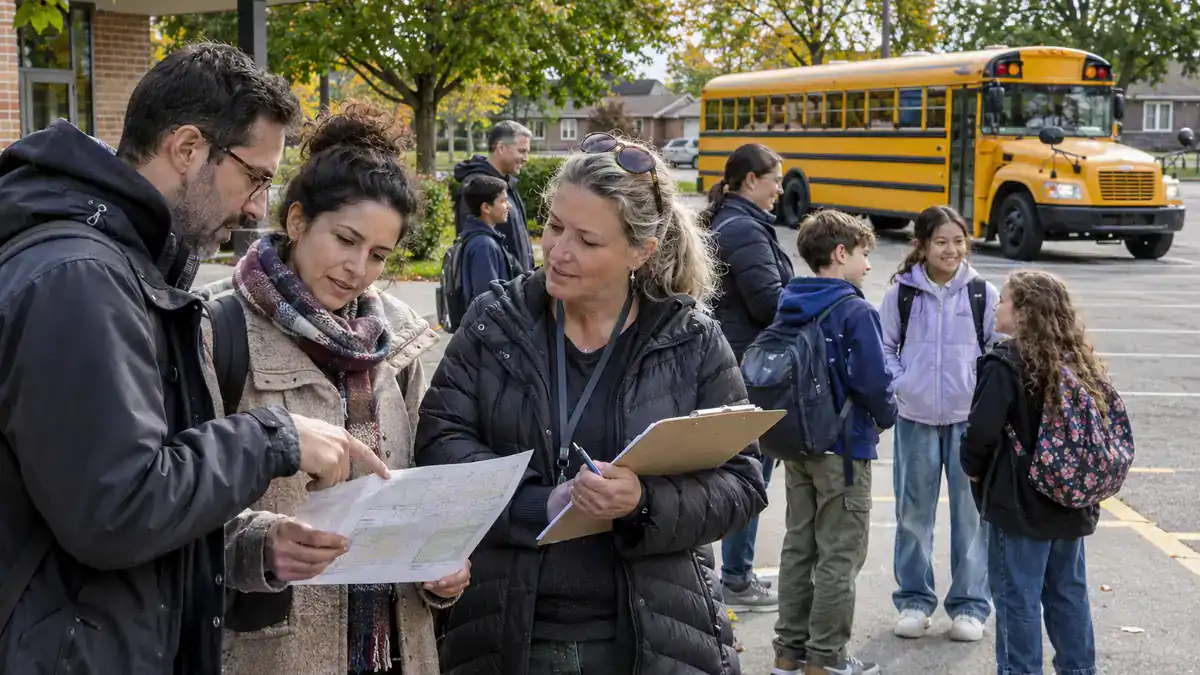
Many Ontario families depend on school-board transportation, but not every student qualifies for a bus. Eligibility and route policies vary by school board and local transportation consortium. A student may live inside the board’s walking distance, attend a school or program outside the designated boundary, or enrol in a private school that does not provide transportation.
When several students from the same neighbourhood are travelling to the same school, a private, parent-funded route may offer another option. Switzer-CARTY provides private school bus transportation services for groups of students, private schools and school communities in areas served by its local operations.
Private service requires more planning than simply adding a student to an existing board route. Understanding how eligibility, participation, routing and costs fit together can help parents and schools determine whether a private route is practical.
Confirm Eligibility for Board Transportation First
Before organizing private transportation, confirm whether the student is eligible for existing school-board service.
School transportation rules are administered locally. Walking distances, school boundaries, specialized programs, accessibility needs and approved addresses may all affect eligibility. Policies can differ between neighbouring boards and even between programs within the same board.
Parents should contact their school or local transportation consortium for a formal answer. School Bus Ontario maintains a directory of Ontario student transportation consortia to help families locate the appropriate regional authority.
If board transportation is unavailable, ask why. Understanding the eligibility decision will help determine whether private service addresses the actual transportation gap.
A private route is most practical when families can assemble a committed group, agree on a consistent schedule and use a small number of safe, convenient pickup points. To discuss a potential parent-funded route, request a school bus transportation quote from Switzer-CARTY Transportation.
What Is a Parent-Funded School Bus Route?
A parent-funded route is transportation arranged privately rather than provided through a school board or consortium.
Depending on the situation, the agreement might be coordinated by:
- A private or independent school
- A parent association
- A group of families from the same neighbourhood
- A childcare or before-and-after-school program
- Another organization responsible for the participating students
The group or organization contracts directly with the transportation provider and is responsible for the cost. The provider evaluates the proposed route, operating area, schedule, passenger count and vehicle requirements before confirming whether service is feasible.
This is generally a recurring transportation arrangement—not an occasional charter trip. The route may operate every school day or according to an agreed schedule throughout the school year.
When Can Private School Bus Service Make Sense?
Private transportation may be worth investigating when:
- Several students from one neighbourhood attend the same school
- A private school wants to expand transportation options for families
- Students attend a specialized program outside their immediate community
- Families live too close to qualify for board transportation but consider the walk impractical
- A new residential community is not served by the desired school route
- Families want a centralized pickup point for students travelling to the same destination
These circumstances do not automatically make a route viable. The number of committed passengers, travel distance, local vehicle availability and operating schedule will all influence the decision.
Begin With a Committed Group
Interest is not the same as commitment. Before approaching a transportation provider, determine how many families are realistically prepared to participate and contribute to the cost.
Create a preliminary list containing:
- Number of students
- Students’ grades or approximate ages
- General neighbourhoods—not publicly shared home addresses
- School name and address
- Required arrival and dismissal times
- Days of the week service is needed
- Accessibility or mobility requirements
- A primary parent or school contact
A single coordinator can simplify communication between the families, school and transportation provider. The coordinator should maintain the participant list, collect questions and distribute confirmed information.
The school should also be involved early. Administrators may need to confirm arrival procedures, dismissal supervision, loading zones and where a privately arranged bus can safely enter and wait.
Use Centralized Pickup Points Where Practical
A route with a separate residential stop for every student can become lengthy and expensive. Centralized pickup points may make the service more efficient and provide more predictable travel times.
Potential locations might include:
- A community centre
- A place of worship
- A designated neighbourhood meeting point
- A commercial property with permission
- Another safe location accessible to participating families
Parents should not independently finalize a stop or assume that any parking lot or roadside location is suitable. The transportation provider must assess whether a bus can enter, stop and depart safely. Property-owner permission may also be required.
Fewer stops can reduce route time, but convenience and student safety must remain central to the plan.
What Determines the Cost?
There is no universal per-student price for private school bus service. Costs depend on the operating requirements of the complete route.
Important factors include:
- Distance between the bus operation, pickup area and school
- Number and location of stops
- Morning and afternoon operating times
- Number of service days
- Route duration
- Number of students
- Vehicle type and capacity
- Accessibility requirements
- Length of the service agreement
The cost per family may become more manageable as the number of committed students increases, but the route must still be operationally practical.
Families should decide in advance how costs will be allocated and what happens if a participant withdraws. The transportation provider can quote the service, but financial arrangements among participating families may remain the responsibility of the organizing group or school.
Ask About Safety, Communication and Accessibility
A private route should be planned with the same attention to consistency and student safety expected from other school transportation services.
Ask the provider about:
- Driver qualifications and training
- Vehicle inspection and maintenance
- Student lists and attendance responsibilities
- Emergency contact procedures
- Route-change communication
- Expectations for student behaviour
- Accessibility accommodations
- Procedures for delays or severe weather
Parents can also review the Government of Ontario’s <a href=”https://www.ontario.ca/page/school-bus-safety” target=”_blank” rel=”noopener”>school bus safety guidance</a> with their children before service begins.
Students with accessibility or mobility requirements should be identified during the initial planning stage so that appropriate transportation can be discussed.
Start Planning Early
A private school bus route requires coordination among families, the school and the transportation provider. Vehicle and driver availability must also be assessed locally.
Beginning several months before the desired start date provides time to:
- Confirm board-transportation eligibility.
- Establish the interested group.
- Select a coordinator.
- Consult the school.
- Develop preliminary pickup areas.
- Request and review a transportation proposal.
- Finalize participation and communicate the route.
Switzer-CARTY operates through numerous local school bus branches across Ontario, but specific service availability depends on the proposed community, route and schedule.
What to Include in Your Initial Request
When contacting a transportation provider, include:
- School name and complete address
- Desired start and end dates
- Morning arrival and afternoon dismissal times
- Estimated number of students
- General pickup neighbourhoods
- Proposed number of centralized stops
- Days of service required
- Accessibility needs
- Name of the organizing school or parent representative
The route does not have to be fully designed before the first conversation. A clear preliminary request allows the transportation team to evaluate feasibility and identify information still needed.
Explore Private Student Transportation
When board transportation is unavailable, a well-organized group of families or a private school may be able to establish a practical alternative.
The strongest proposals begin with confirmed interest, consistent schedules, realistic pickup points and early communication with the school. From there, an experienced transportation provider can assess the route and explain the available options.